
A butterfly valve opens and closes with a quarter turn: a disc mounted on a stem rotates 90 degrees inside the pipe. What separates one butterfly valve from another is where that stem sits relative to the disc and the seat. This single design choice, called the offset, decides how the valve seals, how fast the seat wears and what pressure and temperature it can handle. This article explains the three types found on ships and in plants.
The basic principle
In the open position the disc lies parallel to the flow, so the fluid passes on both sides of it. In the closed position the disc stands across the pipe and its edge presses against the seat. Because the disc stays in the flow path even when fully open, a butterfly valve always causes some pressure drop, but in return it is short, light and inexpensive compared with a gate or globe valve of the same size. That is why butterfly valves dominate large-bore lines such as ballast, seawater cooling and cargo systems.
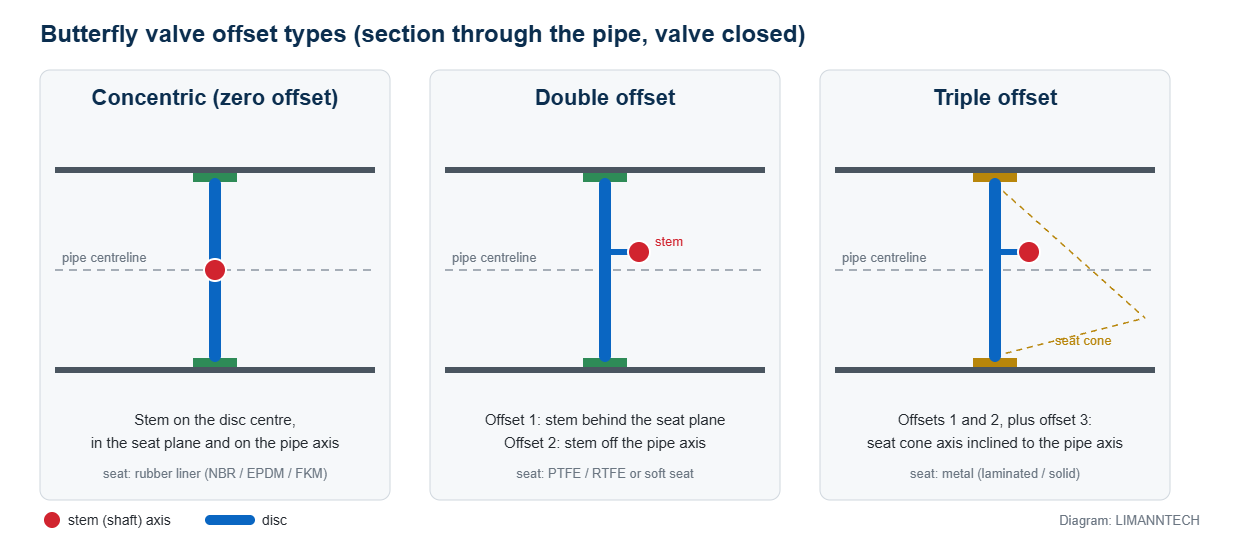
Concentric (zero offset) butterfly valve
In a concentric valve the stem passes through the centre of the disc, in the plane of the seat and on the centreline of the pipe. The body is lined with a rubber seat, usually NBR, EPDM or FKM (Viton), and the disc is slightly larger than the seat bore. Sealing comes from squeezing the disc edge into the rubber.
The disc stays in contact with the rubber through the whole stroke, so friction and seat wear are the weak points. Pressure and temperature are limited by the elastomer. Within those limits the design is simple, bubble-tight and economical, which makes it the standard choice for seawater, fresh water, ballast and bilge lines.

Double offset butterfly valve
A double offset valve moves the stem in two directions. First, the stem sits behind the seat plane instead of in it. Second, it sits slightly to one side of the pipe centreline. Together these offsets give the disc a cam-like motion: it swings clear of the seat within the first few degrees of opening and touches it again only at the very end of closing.
Less rubbing means lower torque and longer seat life. It also allows harder seat materials such as PTFE or reinforced PTFE, so the valve can take higher pressures and temperatures than a rubber-lined valve. Double offset valves are often called high-performance butterfly valves and are common in cargo oil, fuel and process lines.
Triple offset butterfly valve
The triple offset design keeps the first two offsets and adds a third: the seating surface is cut as a section of a cone whose axis is inclined to the pipe centreline. With this geometry the disc seal ring and the seat meet without sliding against each other at any point of the stroke. Contact happens only at the moment of closure, and the seal tightens as closing torque is applied.
Because there is no rubbing, the seat can be metal, either a solid ring or a laminated metal and graphite ring. That makes the valve suitable for steam, hot gas and exhaust lines, cryogenic LNG service and applications that require a fire-safe design, where a rubber or PTFE seat would not survive.

Comparison at a glance
| Concentric | Double offset | Triple offset | |
|---|---|---|---|
| Seat | Rubber liner (NBR, EPDM, FKM) | PTFE, RTFE or soft seat | Metal (solid or laminated) |
| Seat contact while turning | Throughout the stroke | Only near the closed position | None until closed |
| Operating torque | Higher for the size | Lower | Low, torque-seated |
| Typical service | Seawater, fresh water, ballast, bilge | Cargo oil, fuel, process lines | Steam, exhaust gas, LNG, fire-safe duty |
| Relative cost | Lowest | Medium | Highest |
How to choose
- Fluid and temperature first. If a rubber seat can live in the fluid at the working temperature, a concentric valve is usually the most economical answer.
- Pressure and cycling. For higher pressure classes or valves that are operated often, a double offset design reduces wear and torque.
- Extreme temperature or fire safety. Steam, exhaust gas, cryogenic service and fire-safe requirements point to a metal seated triple offset valve.
- Replacing an existing valve. Check the nameplate for type, size, pressure rating, flange standard (JIS, DIN, ANSI) and seat material. The face-to-face length and the actuator mounting must also match.
Butterfly valves from LIMANNTECH
LIMANNTECH manufactures concentric butterfly valves from DN50 to DN1200, double offset valves from DN50 to DN1200 and metal seated triple offset valves from DN50 to DN900 in Busan, Korea. See the butterfly valve page for specifications, or send the nameplate details of the valve you need to replace to sales@limanntech.com. We reply with a quotation within 24 hours.
Butterfly valve brands we supply
Besides its own valves, LIMANNTECH supplies butterfly valves and spare seats from other makers used on ships and in plants: Ace Valve, Keystone Valve, Sejin Valve, DKC Valve, DK TMI, Nakakita Seisakusho and Wonkwang Valve. Hydraulic and pneumatic actuators for them come from SCANA Skarpenord, BY Controls, KSB and HKC.
한국어판: 버터플라이 밸브 작동 원리
